By Jenniffer Paez
Quick Answer: The best-supported benefits of raising a bilingual child are communicating in two languages, stronger social understanding, and no delay in overall language development. Research on broader brain benefits, such as improved executive function, is mixed: some studies find small advantages and others find none.
Will raising a bilingual child make them smarter?
It’s one of the most popular claims about bilingualism, and the honest answer is more nuanced, and in some ways more reassuring, than the headlines suggest. Here’s what the research actually says.
Does Learning Two Languages Confuse or Delay Young Children?
No. This is the concern we hear most from families, and the science is clear. A widely cited research review of parents’ most common questions about early bilingualism, by researchers at Concordia University and Northwestern University, reports that bilingual infants readily tell their two languages apart and show no evidence of confusion. Mixing words from both languages in one sentence, known as code mixing, is a normal part of bilingual development, not a warning sign.
The same review found that bilingual children are not more likely than monolingual children to have language difficulties or delays. Here’s why it can look that way: a bilingual toddler often knows fewer words in each individual language. But when you add up the words a child knows across both languages, the total is about the same as a monolingual child’s.
What Benefits Does Research Support Most Strongly?
Start with the most obvious one, which is often overlooked: your child gets to speak two languages. That opens doors to connecting with extended family, staying close to family culture and history, making friends from different backgrounds, and later, education and work opportunities. The review lists these as core benefits of early bilingualism.
Research has also pointed to social advantages. Bilingual preschoolers seem to have somewhat better skills than monolinguals at understanding other people’s perspectives, thoughts, desires, and intentions, and young bilingual children show more sensitivity to communication cues like tone of voice. That makes intuitive sense. A bilingual child is constantly noticing who speaks which language and adjusting.
Timing matters, too. The research converges on a simple take-home: earlier is better. There’s no sharp cutoff, but language-learning ability declines gradually with age, and children who learn two languages from birth tend to have advantages over later learners in accent, vocabulary, and grammar. That said, learning a second language is possible at any age.
Does Bilingualism Give Children a «Brain Boost»?
This is the claim you’ve probably seen in headlines: that juggling two languages trains executive function, meaning attention, self-control, and mental flexibility. It’s an appealing idea, and some early studies supported it. But the research has become more mixed.
A meta-analysis of 170 studies found that bilinguals outperformed monolinguals on some executive function tasks, but that the advantage depended on the task and the age of the participants. By contrast, a meta-analysis of more than 1,100 effect sizes from about 10,900 bilingual and 12,500 monolingual children ages 3 to 17 found only a small overall effect, and that effect was indistinguishable from zero once the authors adjusted for publication bias.
Even the researchers who describe these advantages urge caution. The early-bilingualism review above notes that they’ve mostly been shown with sensitive laboratory tasks, that it isn’t known whether they matter in everyday life, and that other enriching early experiences, like music training, are linked to similar advantages.
So here’s our take: choose bilingual learning for what it clearly gives, two languages, a wider circle of connection, and a strong start at communicating. Treat any extra brain benefit as a possible bonus, not a promise.
What Matters Most for Children Learning Two Languages?
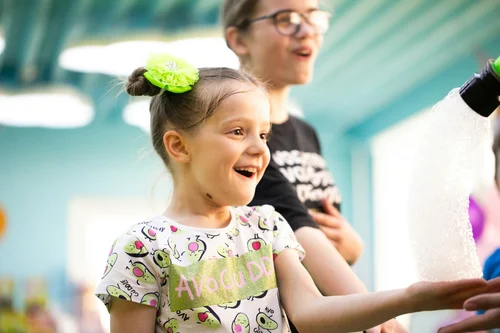
If there’s one thing the research agrees on, it’s that exposure matters. Both quality and quantity count. Children need plenty of exposure to each language, and the best exposure is social: real conversation with real people, rather than passive screen time. Hearing several different speakers also supports vocabulary growth in bilingual toddlers.
Relatively balanced exposure gives children the best chance of learning both languages, while occasional exposure, like a weekly class, is unlikely to be enough on its own. That’s one reason steady, everyday immersion matters so much.
What Does This Look Like at Pequeños Genios?
We built our program around steady, natural, social exposure. During the day, we primarily speak Spanish in our routines, playtime, meals, diaper changes, and everyday conversations, and we use English when needed so every child understands important instructions and feels safe.
Since research favors real conversation over screen time, that’s how we work, too. We don’t use screens with the children at all, so their exposure to both languages comes entirely from real people and real interaction throughout the day.
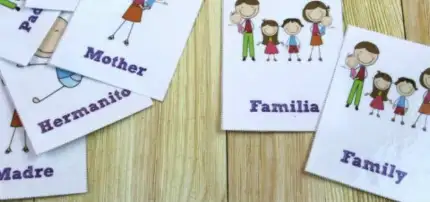
Our curriculum and lesson plans are fully bilingual, and language isn’t a separate subject here. It’s woven into everything children do. We sing songs in both languages and introduce new vocabulary each month, and Spanish and English also run through math, STEAM (science, technology, engineering, art, and math), art, sensory experiences, motor activities, and social-emotional learning, just as they run through routines, meals, and play. Children aren’t studying a second language during a set lesson time. They’re using it to count, create, explore, move, and talk about how they feel.
Just as important is the pace. Jenniffer describes it this way:
«We don’t expect them to speak Spanish from day one. First they listen, then they understand, then they respond, and when they’re ready, they begin to speak.» — Jenniffer Paez, Owner, Pequeños Genios
Research is clear that lasting bilingualism depends on continued exposure and practice as children grow, so we focus on what we can do every day: a warm, low-pressure environment where two languages are simply part of life from an early age.
What Should Parents Take Away?
-
Learning two languages doesn’t confuse or delay young children
-
The best-supported benefits are communication, family and cultural connection, and social understanding
-
The evidence for an executive function boost is mixed, so think of it as a possible bonus
-
Earlier is better, but it’s never too late to learn a second language
-
Quality and quantity of exposure both matter: real conversation, many hours, and more than one speaker
Is There a Bilingual Daycare in Sultan, WA That Immerses Children in Spanish and English?
Yes. Pequeños Genios is a licensed, home-based bilingual daycare in Sultan, WA for children 3 months to 13 years. Spanish and English are woven through the whole day, from routines and meals to songs, stories, and play, and we accept DSHS/WCCC childcare subsidy.

What Makes Pequeños Genios Special?
-
Licensed home childcare in Sultan, WA through Washington State DCYF, and an Early Achievers Level 3 Plus program continuing to grow toward Level 4
-
Bilingual immersion: Spanish is woven through our routines, songs, meals, and play, with English used whenever it’s needed to keep every child safe and understood
-
Montessori Hybrid learning: core Montessori principles blended with play-based, outdoor, sensory, and project-based experiences
-
Mixed-age groups, predictable routines, and homemade meals
-
Ages 3 months to 13 years, Monday through Friday, 6:00 AM to 5:30 PM
-
DSHS/WCCC accepted
Ready to see if we’re the right fit? Contact us to schedule a tour, or start your registration. You can also call us at (360) 554-9353 or email [email protected]. We’re located at 107 Willow Avenue, Sultan, WA 98294.
FAQ about Raising a Bilingual Child
Does raising a child bilingual delay language development? No. Research shows bilingual children are not more likely than monolingual children to have language difficulties or delays. A bilingual toddler may know fewer words in each language, but their total vocabulary across both languages is about the same as a monolingual child’s.
Does being bilingual improve a child’s executive function? The research is mixed. Some meta-analyses find small advantages on certain tasks and ages, while a large meta-analysis of children ages 3 to 17 found an effect that was indistinguishable from zero after adjusting for publication bias. It’s best viewed as a possible bonus rather than a guaranteed benefit.
What are the best-supported benefits of raising a bilingual child? The clearest benefits are the ability to communicate in two languages, closer connections with family and culture, and somewhat stronger perspective-taking skills in bilingual preschoolers. Bilingual children also show no evidence of language confusion or delay.
What is the best age to start learning a second language? Research points to earlier being better, because language-learning ability declines gradually with age rather than at a sharp cutoff. Children who learn two languages from birth tend to have advantages in accent, vocabulary, and grammar, but learning a second language is possible at any age.
How much exposure does a child need to become bilingual? Researchers generally consider a child bilingual when they receive at least 10 to 25 percent of their exposure in each language, though that level does not guarantee fluency. Both quality and quantity matter, and the best exposure is social, with real conversation and more than one speaker.
How does Pequeños Genios support bilingual development? Spanish is our primary language during routines, playtime, meals, and everyday conversation, and we use English when needed so every child understands and feels safe. Our fully bilingual curriculum weaves both languages through songs, monthly vocabulary, math, STEAM (science, technology, engineering, art, and math), art, sensory experiences, motor activities, and social-emotional learning, so children use Spanish all day long, not just during a lesson.
Does Pequeños Genios use screens with children? No. We don’t use screens with the children. Research shows the best language exposure comes from real conversation with real people rather than passive screen time, so at Pequeños Genios, children hear and use Spanish and English entirely through real interaction throughout the day.