What Does a Typical Day Look Like at a Home-Based Daycare?
By Jenniffer Paez
Quick Answer: A typical day at Pequeños Genios follows a consistent rhythm — arrival and free play, structured learning activities, outdoor time, meals, and a rest period — all woven with bilingual Spanish-English interaction throughout. Predictable routines help children feel secure while giving them room to explore at their own pace.
Why Routine Matters More Than a Minute-by-Minute Schedule
Parents often picture a «schedule» as a rigid list of times and tasks, but what actually matters most for young children is predictability, not precision.
That’s the philosophy behind how we structure our days — enough consistency to feel safe, enough flexibility to follow a child’s pace.
A Sample Day at Pequeños Genios
(Times below are illustrative and based on my best guess — Jenniffer, please confirm actual blocks and adjust as needed.)
6:00–8:30 AM — Arrival & Free Play Children arrive gradually throughout the morning window. Early arrivals settle in with quiet, open-ended play — blocks, books, sensory bins — while caregivers greet each family individually.
8:30–9:00 AM — Breakfast Home cooked meals rich with vitamins, minerals and protein are prepared daily to feed growing minds and bodies. Meals are individually tailored to meet each child’s needs and dietary restrictions.
9:00–9:30 AM – Freetime
I would love to explain that this isn’t simply «free play.» Our classroom is intentionally organized into different learning areas (reading, blocks, dramatic play, sensory, art, writing, math, music, puzzles, etc.), and each area has a specific learning purpose.
Children choose where they would like to play based on their interests, sometimes independently and sometimes with friends. During this time, we carefully observe how they interact, communicate, solve problems, and develop new skills. Those observations help us plan future activities based on each child’s development and interests.
9:30–9:50 AM – Morning Circle
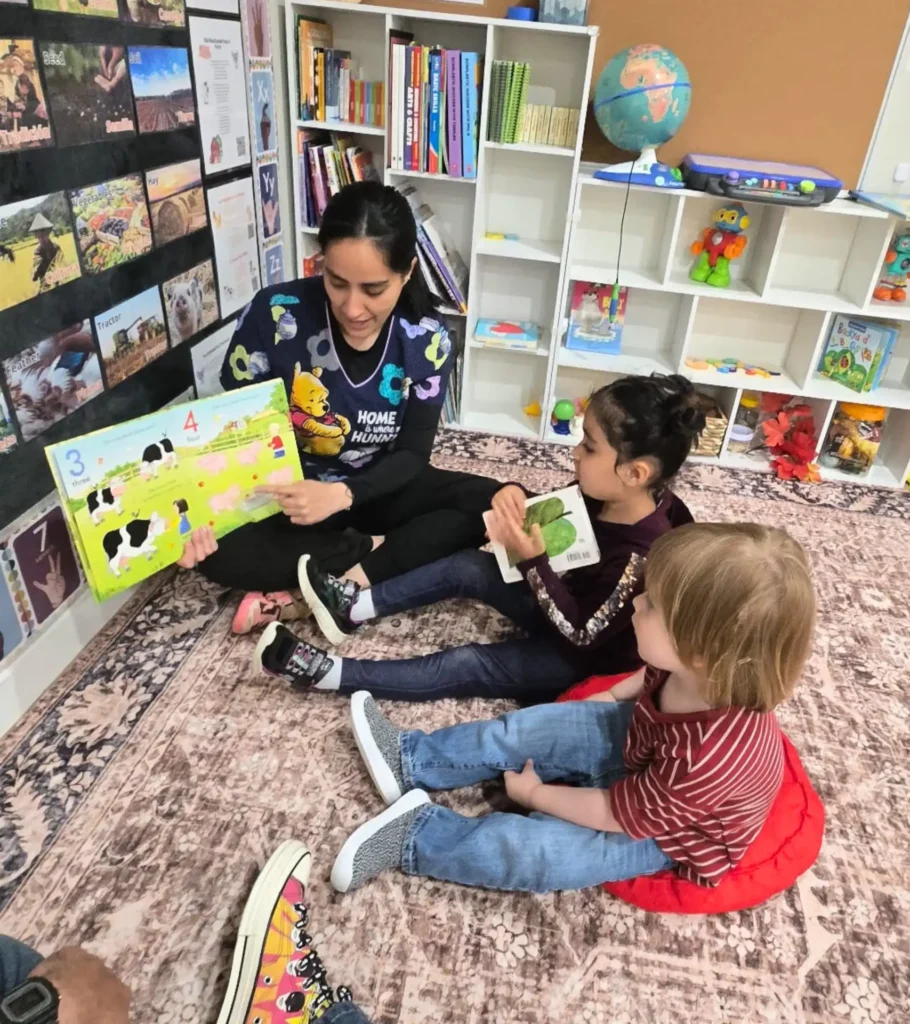
Our morning circle is a very important part of the day. We begin by greeting each child with «Buenos días,» then we talk about the day of the week, the weather, and the calendar. We review the alphabet, count from 1 to 10, practice our monthly vocabulary, read our book of the month, and learn about our character of the month. We also sing songs in both Spanish and English.
9:50–10:15 AM – Main Learning Activity
After circle time, we move to the tables for the main activity of the day. All of the children participate in the same activity, but it’s carefully adapted to each child’s developmental level. Our younger children explore through sensory experiences and early fine motor skills, while our older children work on more advanced concepts. I think this also highlights one of the strengths of our mixed-age classroom. Both Spanish and English so children absorb both languages through repetition and routine.
10:15-11:30AM — Outdoor Play
Weather permitting, children head outside for gross motor play, nature exploration, and sensory activities.
11:30–12:30 AM — Handwashing & Lunch
A sit-down meal with conversation modeled in both languages, reinforcing vocabulary naturally rather than through formal instruction.
12:30 PM–3:00 PM — Reading Time & Quite Activities
1:00 PM–3:00 PM —Rest / Nap Period Infants and toddlers nap on individual schedules; older children have quiet rest time with books or calm activities.
3:15–3:30 PM — Afternoon Snack
3:30–4:00 PM — Small Group Activity and Story Montessori Hybrid activities suited to each age group — hands-on materials, fine motor practice, early literacy or math concepts — with children moving at their own pace rather than a single fixed lesson for the whole room.
4:00–5:00 PM — Outdoor Play, Snack & Departure Window Whenever possible, we spend this time outside. However, because many children are picked up between 4:30 and 5:30, we sometimes stay indoors to make transitions smoother. During that time, children choose calm activities like books, puzzles, blocks, or other learning centers while waiting for their families.
We also offer a light snack (like Cheerios) for children who stay later in the afternoon to help them stay comfortable until pickup.
Why a Home-Based Setting Feels Different
Because Pequeños Genios operates out of a home rather than a large center, children experience something closer to an extended-family rhythm than an institutional schedule.
Small group sizes mean caregivers can genuinely adjust the day around individual needs — an early nap for a tired toddler, extra outdoor time on a nice day — without disrupting a whole classroom of children.
Spanish and English aren’t treated as separate «subjects» — they’re woven through every part of the day described above, from morning circle songs to mealtime conversation to outdoor play. Children absorb vocabulary the same way they picked up their first language: through repetition, context, and connection with trusted caregivers.
Want to see it in person? Schedule a tour and we’ll walk you through a typical day for your child’s specific age group.
What Does a Day at a Home Daycare Look Like in Sultan, WA?
Families new to home-based care in Sultan often ask how it differs from a larger center. At Pequeños Genios, the answer is a smaller, more personalized version of the same core rhythm — arrival, structured and free play, meals, rest, and outdoor time — with more one-on-one attention throughout the day than a larger classroom typically allows.
What Makes Pequeños Genios Unique?
Our home-based setting means small group sizes and genuine flexibility around each child’s needs, all built around our Montessori Hybrid approach and delivered bilingually in Spanish and English throughout the day. As a Level 3 Early Achievers program, we’re continually strengthening our daily practices to support each child’s development.
Curious what a typical day looks like for your child’s age group? 📧 [email protected] 📞 (360) 554-9353 🔗 Contact us
FAQ about a Typical Day at Pequeños Genios
What time does the day start and end at Pequeños Genios? We’re open Monday through Friday, 6:00 AM to 5:30 PM, with flexible arrival and departure windows to accommodate different family schedules.
Do all children follow the same schedule regardless of age? No. Infants and toddlers follow individual rhythms, especially for naps and feeding, while older children follow a more structured group routine.
How much of the day is spent outdoors? Outdoor time is built into both the morning and afternoon, weather permitting, as part of our Montessori Hybrid approach to hands-on, sensory-rich learning.
Is Spanish taught as a separate lesson, or part of the whole day? Spanish and English are woven throughout the entire day — circle time, meals, play, and transitions — rather than taught as a standalone lesson.
What happens during nap or rest time for children who don’t nap anymore? Children who no longer nap have a quiet rest period with books or calm independent activities instead.
How is a home-based daycare day different from a larger childcare center? Smaller group sizes allow more flexibility and individual attention throughout the day, while still following a consistent, predictable overall rhythm.